By clicking “Accept”, you agree to the storing of cookies on your device to enhance site navigation, analyse site usage, and assist in our marketing efforts. View our Privacy Policy for more information.

Insights

Explore the latest skills research showcasing the powerful and far-reaching impact of essential skills worldwide. Discover research and impact reports on essential skills.

October 2025

Joining up the journey

Click to read the research

This report explores how embedding Skills Builder essential skills supports learners during the critical transition from primary to secondary school.

Key findings are presented in two parts:

The analysis first examines the role of essential skills in transition within three educational structures: Multi-Academy Trusts, Local Authorities, and All-through Schools.

Drawing on research and effective practice from partner schools, the report then identifies five key themes that show how essential skills support this transition:

  1. Bridging curriculum learning
  2. Settling learners into their new environment
  3. Helping learners integrate into new peer groups
  4. Linking the transition process to future careers
  5. Fostering an inclusive transition experience

Based on these insights, the report concludes with five key recommendations for schools to leverage essential skills in supporting the transition process.

October 2025

Piloted models of developing workplace attitudes and behaviours in education

Click to read the research

This report details the how essential skills can support the development of workplace attitudes and behaviours, through the Universal Framework. It continues our work in conjunction with the Commercial Education Trust, following the initial piece 'Attitudes, Behaviours and Essential Skills' (2024). It covers action research we undertook in 2024-25 to explore scaleable models of teaching workplace attitudes and behaviours through essential skills.

87% of participants in our trial approach to building workplace attitudes and behaviours through essential skills indicated they were very likely to use the strategies and resources, indicating a model which could be easily scaled across a variety of educational settings. The report includes an overview of training models for educators, and details how the Universal Framework review further supports the development of workplace attitudes and behaviours.

September 2025

Speaking and Listening at scale

Click to read the research

This toolkit builds off the Oracy Commission’s Future of Oracy Education report to provide a detailed blueprint for formally integrating Speaking and Listening skills - also called oracy - into the national curriculum. 

The Commission’s report identified a "patchy and inconsistent" national picture of oracy provision. This paper offers a transparent, actionable, and unifying structure for skill development.

With research summaries, learnings from other policies and case studies, it acts as a useful tool for policy makers. Building speaking and listening in schools through the national curriculum presents a huge opportunity to break down barriers to opportunity by preparing learners for life and work.

Jul 2025

The Skills Builder Handbook for Educators (UF2)

Click to read the research

Skills Builder’s Universal Framework is a transformational model for how we equip every learner with these essential skills, and provides a rigorous, step-by-step model for doing so. Already used with more than 1.8 million learners across twenty countries, it is the result of cutting-edge research and practice more than 15 years in the making.

This Handbook is designed by and for educators to build and track their learners’ essential skills. It includes age- and stage-related expectations for each skill, provides information about the good practices that support skills development, and provides the detail of how to teach, practice, and assess each step of progress.

June 2025

Universal Framework Review 2025: Final Report

Click to read the research

Over 12 months, we carried out a complete review of UF1.0 from every angle

We explored users’ experiences through open consultation, engaged experts and partners through roundtables, explored international examples and settings, and analysed thousands of anonymised individual and class assessments against UF1.0.

The result was ten recommendations which evolved the Framework while maintaining its core design and principles. The result is more usable, inclusive, internationally relevant, and future-proofed for the next ten years.

May 2025

Essential Skills Tracker 2025

Click to read the research

Essential skills are revealed to be an important - and popular - part of the AI transition. The research shows these skills to be a predictor of AI adoption and to reduce anxiety about regular AI use. The paper also builds on the evidence of the relationship between essential skills and life outcomes.

September 2024

Attitudes, Behaviours and Essential Skills

Click to read the research

This paper provides a deep-dive into workplace attitudes and behaviours. It seeks to identify the most important attitudes and behaviours for the world of work, and to evaluate different strategies for their teaching and assessment. The paper draws on research and best practice in the teaching and assessment of essential skills, using these to identify opportunities to develop workplace attitudes and behaviours.

July 2024

Essential Skills at Scale

Click to read the research

Essential Skills at scale outlines policy recommendations for ensuring that every child and young person benefits from high quality opportunities to build their essential skills. At a low cost, the right teacher training opportunities, curriculum adaptation, assessment approaches and accountability measures can realise this ambition. Implementing these policy recommendations will help realise the government’s vision of an education system that is equitable, inclusive, and delivers the skills that businesses are demanding.

March 2024

Essential Skills Tracker 2024

Click to read the research

The Essential Skills Tracker 2024 shows that teaching professionals are overwhelmingly in support of building essential skills in education. These nationally representative findings, based on YouGov sampling of 1,006 teachers, reveal they have positive views on how they can be taught and It is clear that a system-wide approach to teaching essential skills is required if it is to succeed.

November 2023

Certifying Essential Skills

Click to read the research

This report considers how both formal qualifications and informal certifications can effectively aid the recognition of essential skills. 

Part one provides overview of the types of qualifications and certifications that assess and recognise essential skills in the UK. 

The second part discusses how informal certifications can be used to effectively recognise informal or non-formal learning of essential skills. 

Guidance also provided for those wishing to create digital badges for participation in essential skills experiences, plus guidance on when the Skills Builder Partnership would be willing to endorse such badges. 

In the final section, we provide best practice guidelines for awarding bodies wishing to create essential skills qualifications - approved and endorsed by the Skills Builder Partnership.

March 2023

Essential Skills Tracker 2023

Click to read the research

By taking a complete approach to skills, this research reveals the staggering cost of low essential skills in the UK. This contribution to the literature on the returns to skills shows how people with higher levels of essential skills have higher earnings, higher job satisfaction, higher life satisfaction and higher social mobility.

September 2022

Trailblazer Report 2022

Click to read the research

This paper brings you practical insights on why and how to build essential skills into your business. It is based on years of research by professionals and academics as well as practical experience, with case studies from a range of employers that have leveraged a structured approach to skills in order to boost their recruitment, staff development & outreach.

September 2022

The Skills Builder Handbook for Educators (UF1)

Click to read the research

Over the last decade, the Skills Builder approach has transformed the teaching of essential skills in education systems and classrooms across the world.

Essential skills like communication, collaboration, creative problem solving and self-management having long been called for.

New evidence shows that these skills unlock learning in the classroom, boosting academic outcomes, perseverance and self-belief. They halve the likelihood of being out of work, and increase earnings across a lifetime. They even boost wellbeing and life satisfaction.

But access to these skills isn’t fair. As educators, it can be difficult to go from knowing these skills matter to how to teach them in the classroom with real rigour.

Published in full for the first time, this Handbook helps any educator to use the Skills Builder approach with their learners – whether in primary school, secondary school, college or special school.

It starts by exploring how skills are built, and the key principles that make a difference. Principles that include being transparent about the steps to mastery, working across all ages, assessing skills robustly, directly teaching core tools and concepts, and then practicing them in lots of settings.

By breaking essential skills down into teachable steps, educators can dip in and out of this Handbook to assess, teach, and practice each skill step in turn for learners at all ages and stages. In doing so, educators can accelerate learners’ mastery of these skills, and navigate them to success.

March 2022

Essential Skills Tracker 2022

Click to read the research

There have long been calls for greater emphasis on essential skills, whether from business organisations, or from educators. But evidence on essential skill levels across the UK is limited.

The Essential Skills Tracker changes that. For the first time, we have a complete picture of how adults across the UK are building and using their essential skills – and where the gaps are.

In collaboration with YouGov, more than 2,200 adults completed an assessment against the Skills Builder Universal Framework. These assessments of essential skills including teamwork, communication, and creativity skills were then linked up with key demographic, job, education, and earnings data.

What did we learn? Read inside to find out.

June 2021

Essential skills: Teachers' perspectives on opportunities and barriers

Click to read the research

This research piece was led by Emma Crighton, a member of our Education Team at Skills Builder. The paper channels the voices of teachers and their motivations around building essential skills for their learners. It also explores the barriers teacher face and how Skills Build can address some of these, as well as where wider policy change is needed. Speaking to teachers within and beyond the Skills Builder network, as well as seven leaders in the education sector, the insights gathered include:

  • Five key motivators for teachers when it comes to building essential skills for their learners: to prepare students for life, to support career development and employability, to unlock learning and opportunities for all, to support strategic priorities and to raise aspirations.
  • Time and a lack of training and consistent approach towards essentials skills prevent teachers from building essential skills universally. A further barrier stems from wider policy restrictions with regard to the value placed on essential skills. These restrictions include performance and attainment measures, the current knowledge-based curriculum and the reduced scope of collaboration between education institutions
  • Teachers and sector leaders suggest some possible solutions, including: increased teacher training, a redesign of the curriculum, a review of the accountability system and capitalising on the flexibility in the current system.
  • The Skills Builder partnership is seen to support schools and colleges to overcome challenges in seven key areas.
  • Whilst Skills Builder will continue to encourage teachers to tap into their motivations to teach essential skills, change is needed at a policy level to move towards a more supportive education system which places higher value on essential skills.
February 2021

Better prepared: Essential skills and employment outcomes for young people

Click to read the research

This report is built off a new research study conducted with YouGov including more than 3,000 young people aged 16-24 years-old. Individuals completed a self-assessment against the Skills Builder Universal Framework, as well as sharing other outcomes data. Insights generated include:

  • That higher levels of essential skills are correlated with higher social advantage and greater levels of parental engagement, and inversely correlated with attending an Alternative Provision setting or having a special educational need.
  • Overwhelmingly, young people see the value of essential skills across key aspects of their lives for transition, including academic performance (78%), university entrance (66%), successful recruitment (91%), progression in employment (91%), and overcoming wider life challenges (89%).
  • There are strong links between higher essential skill scores and self-efficacy and perseverance of effort.
  • There is evidence of a wage premium of around 15% or £3,400 per year for full-time workers aged over 19 moving from the 1st percentile of skills score up to the median. This wage premium is substantially increased in cases where young people report confidence in applying their essential skills in a range of scenarios. In this case, the wage premium for those individuals rises to £10,200.
January 2021

Essential skills and their impact on education outcomes

Click to read the research

This report is built off new analysis of the British Cohort Study, creating proxy measures for essential skill levels when individuals were aged 10- and 16-years-old in 1980 and 1986 respectively. The analysis sought to test five hypotheses, by linking together datasets around the British Cohort Study (1970). In doing so, we found that higher levels of self-reported essential skills levels are associated with:

  • Higher levels of literacy at primary school, as measured by the Edinburgh Reading Test
  • Higher levels of numeracy at primary school, as measured by the Friendly Math Test
  • Higher levels of mathematics qualifications at secondary school, as measured by O-Level and CSE results
  • Higher academic performance, as perceived by teachers
  • Higher levels of career aspiration
October 2020

How do essential skills influence life outcomes? An evidence review

Click to read the research

This report was written by the Centre for Education & Youth with the Skills Builder Partnership, and reviewed existing robust academic studies exploring the links between essential skills and wider life outcomes. The report highlighted evidence of three links:

  • That essential skills support academic outcomes, particularly through the focus on self-management skills of Aiming High and Staying Positive, as well as communication skills of Listening and Speaking.
  • That essential skills support positive employment outcomes, including higher wages.
  • That essential skills support social and emotional wellbeing, as well as preventing negative behaviours.

Where studies in this review explored the features of effective delivery, they indicated that essential skills interventions tend to be more effective when regular, long term, explicit, embedded, structured, supported and targeted.

May 2020

Towards a Universal Framework for Essential Skills

Click to read the research

This report brings together analysis of the Skills Builder Framework and how it could be extended to act as a universal framework – equally relevant to individuals at all stages of their education or careers. Developed as part of the Essential Skills Taskforce, the work reviewed the completeness and relevance of the existing Skills Builder approach through four comparative lenses:

  • International examples of employability frameworks
  • Job advertisement data
  • Apprenticeship standards
  • Universities’ graduate attribute statements

The framework was the tested through a series of roundtables with employers, educators, and other individuals to ensure that it was not only rigorous but usable. The final result was the Skills Builder Universal Framework.

October 2017

The Missing Piece: The Essential Skills that Education Forgot

Click to read the research

This book was written by Skills Builder’s founder, Tom Ravenscroft, reflecting on the lessons learned over the organisation’s first eight years. Drawing on experience and the broad literature around education and skills development, the book explores:

  • The gap between the apparent need for essential skills and how they are built in the education system.
  • The myths and misconceptions about skill development that hold us back.
  • Which skills are truly essential and how they can be defined and broken down.
  • The principles for building skills in different settings.
September 2017

Enterprise Skills: Teachability, Measurability, and Next Steps

Click to read the research

This report, written by LKMco (now the Centre for Education & Youth), reviewed the evidence around enterprise education and the best-practice principles developed by Enabling Enterprise (now Skills Builder Partnership). This evidence review was complemented by a roundtable in January 2017, and five case studies of primary and secondary schools using the approach around the country.

The report highlighted that:

  • Evidence suggested that specific skills could have a positive impact on the development of young people, and schools felt that there were positive effects on academic performance.
  • Skill development can be measured and tracked, and schools were using the Skills Builder Framework as a useful tool in this regard.
  • There are differences in essential skills by socio-economic background and if unaddressed these gaps could persist throughout education.

The report highlighted priorities to:

  • Build consensus around the language of essential skills, bringing greater coherence to work taking place across the education sector.
  • Promote ways of assessing essential skills that provides useful feedback for pupils and their teachers, helping young people’s ability and confidence in these skills grow.
  • Develop a rigorous evidence base exploring how these skills vary by children and young people’s backgrounds, and what works in closing any gaps that appear.
December 2025

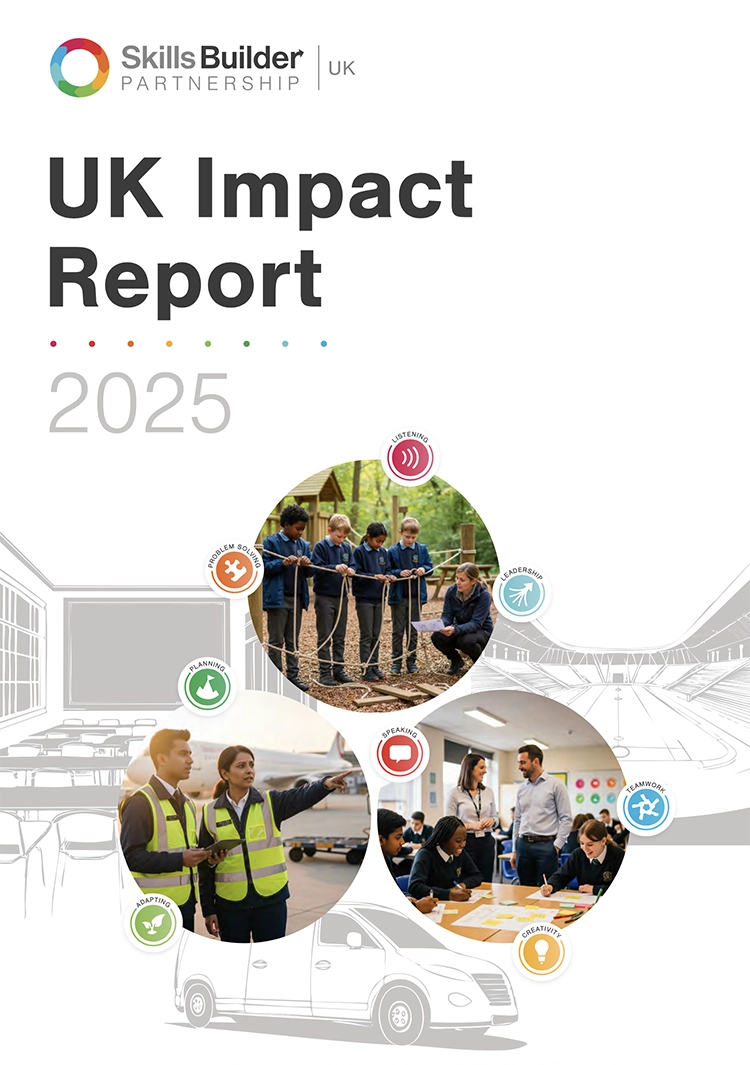
Impact Report 2025

Click to read the research

Our UK Impact Report shows how essential skills are being built across the country. Over the last year, 898 partners have delivered 2,370,000 individual opportunities to boost essential skills in the UK. Since 2020, this has totalled more than 6,760,000 high quality opportunities.

Thank you! Your submission has been received!
Oops! Something went wrong while submitting the form.
Extra-curricular activities, soft skills and social mobility
DfE
2019
Theme:
Essential skills and life outcomes
Extra-curricular activities, soft skills and social mobility
DfE
2019
Theme:
Essential skills and life outcomes
Extra-curricular activities, soft skills and social mobility
DfE
2019
Theme:
Essential skills and life outcomes